Product Catalogue vs PDF: Why a Live Link Beats a File
A PDF catalogue is out of date the day it is exported. A comparison of PDF, website builders and live gallery catalogues on the things that matter: updates, phones, sharing and what happens at version four.
Short answer
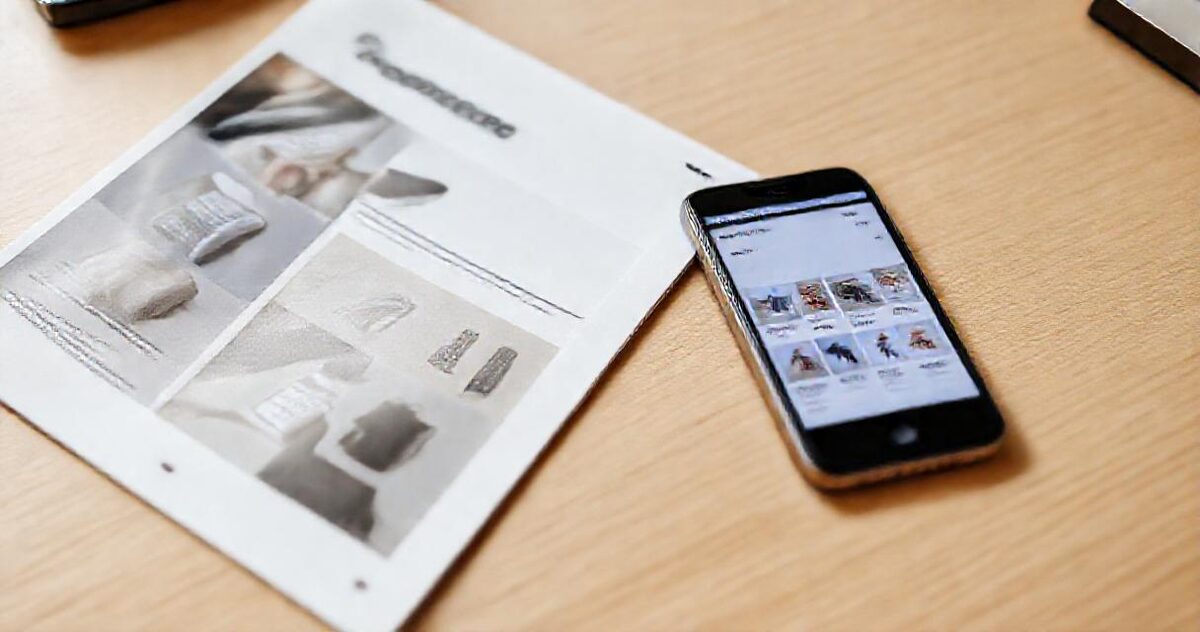
A PDF freezes your range at the moment of export, reads badly on phones, and forks into versions the moment you email it twice. A live catalogue is one link that always shows the current range, opens instantly on a phone, and needs no re-sending when something changes. The PDF survives only where print is the actual requirement.
Every small brand hits the same afternoon: the range has changed, the catalogue is a PDF, and someone has to open the design file, swap the photos, re-export, and email it to everyone again, knowing that half the recipients will keep quoting from the old file anyway. The problem is not the design tool. The problem is that a PDF is a photograph of your range on one particular day.
- The three ways to have a catalogue
- The comparison
- Updates: the deciding factor
- Phones, where catalogues are actually read
- The version four problem
- Where the PDF still wins
- Common questions
The three ways to have a catalogue
The PDF, designed in Canva or InDesign, exported, attached. The website builder, a Squarespace or Wix section rebuilt product by product. The live gallery, a page that reads your photo folder directly, like a catalogue built from a Drive folder.

The comparison
| Website builder | Live gallery | ||
|---|---|---|---|
| Updating a product | Re-design, re-export, re-send | Log in, edit the page | Change the file in the folder |
| Time to first catalogue | Hours of layout | A weekend | Minutes |
| On a phone | Download, then pinch-zoom A4 | Good, if the theme is | A grid built for phones |
| Stale copies in the wild | Guaranteed | No | No |
| Trade vs public view | Two files, both drifting | Password plugins | Second gallery, one password |
| Buyer asks about an item | They type an email from memory | A contact form somewhere else | A button on the photo itself |
| Ongoing cost | Design time per revision | $16 to $30 a month | Free to $5 a month |
| Print handout | Its natural home | Poor | Export on request |
Updates: the deciding factor
A catalogue is a claim about what you sell right now, and its value decays with every day since export. The PDF's whole nature is to freeze that claim. The website builder fixes staleness but introduces its own tax: every product exists twice, once as a photo in your folder and once as a page element, and the two drift the week you are busiest. The live gallery removes the duplication entirely, because the folder is the catalogue. There is nothing to reconcile, which means there is nothing to forget.
Phones, where catalogues are actually read
Buyers open catalogues from an Instagram bio, a WhatsApp message, a QR code on a counter. That is a phone screen every time. A PDF on a phone means a download, a file that opens in whatever app claims it, and pages designed for paper being pinched around a five inch display. A gallery loads resized previews in a scrolling grid, which is what every app has trained every buyer to expect. This is not an aesthetic preference; it is the difference between a catalogue that gets browsed and one that gets closed.
The version four problem
Email a PDF twice and you have created a versioning system with no version control. Someone is always quoting from the file you sent in March, and the file itself carries no hint that it is stale. A link cannot do this. There is no version of a link: there is only what it shows when opened, which is the current range, at the current prices, in the current order.
Where the PDF still wins
Honestly: print. A trade fair handout, a lookbook that gets couriered with samples, a buyer who explicitly asks for "the PDF". Some wholesale workflows are built around attachments and will be for years. The workable compromise is to make the live link the catalogue, and export a PDF from it when someone genuinely needs paper, accepting that the paper copy is a snapshot and treating it accordingly.
Common questions
Can I have both? Yes, and most sellers should: the link as the source of truth, PDFs as dated snapshots for whoever asks.
What about buyers who want prices in writing? Captions can carry prices in the gallery, and a quote sent from an inquiry is in writing by definition.
Is a live catalogue harder to control? The opposite. One address, one current truth, and a password on the trade view. Control is exactly what the PDF loses the moment it is sent.