How to Choose a Wedding Photographer: A Practical Guide
Every portfolio looks good. Here's what to look for beyond the highlight reel, the questions that actually reveal something, what price levels genuinely buy, and the warning signs worth walking away from.
Short answer
Ask every shortlisted photographer for one complete wedding gallery rather than a portfolio, ideally shot in conditions like yours. A portfolio shows twelve good frames from an eight hour day, while a full gallery shows whether the hundredth photo is as good as the first. Then ask what happens if they are ill, and book the one whose answer is immediate and specific.
Choosing a wedding photographer is one of the larger discretionary decisions of the whole wedding, and it's made hardest by the fact that every portfolio looks good. Photographers show their best twelve frames; the difference between an excellent photographer and an adequate one isn't visible in those twelve. It shows up in the other nine hundred, in how the day runs, and in what happens after.
This is a practical guide to choosing well: what to look for beyond a portfolio, the questions that actually reveal something, what different price levels genuinely buy, and the warning signs worth walking away from.
Table of Contents
- Start with what you actually want
- Looking past the portfolio
- Styles, in plain language
- What price levels actually buy
- The meeting: what to ask
- Warning signs
- Before you sign
- The part everyone forgets: delivery
Start with what you actually want
Before looking at a single portfolio, agree between you on three things. It saves weeks.
- How present should the photographer be? Some couples want someone invisible who documents; others want a director who will confidently arrange sixty people for a group shot. Both are legitimate, and photographers are rarely equally good at both.
- What are the non-negotiable photographs? Usually a handful: the two of you, the family group with the grandparent who may not be here next year, the room full of people you love.
- What's the actual budget? Not the aspiration — the number. Wedding photography commonly runs 10–15% of a wedding budget, and knowing your figure early stops you falling for someone at double it.
Looking past the portfolio

Ask to see a full wedding
This is the single most useful request you can make, and surprisingly few couples make it. A portfolio is a highlight reel — anyone with a decent eye produces twelve good frames in an eight-hour day. Ask to see one complete wedding gallery, start to finish.
What you're looking for: consistency in the hundredth photo as much as the first, whether unposed guests look good or awkward, whether the light was handled when the reception got dark, and whether the day reads as a story rather than a set of pretty pictures. A photographer who is proud of their full deliveries will send one immediately. Hesitation is information.
Look for your conditions
Portfolios skew to golden hour in beautiful venues. Ask specifically for a wedding shot in circumstances like yours: a dark church, a rainy day, a small home ceremony, a venue with fluorescent lighting, an outdoor midday summer wedding with harsh sun. How a photographer handles difficult conditions is a far better predictor than how they handle perfect ones.
Styles, in plain language
| Style | What it means in practice | Suits you if |
|---|---|---|
| Documentary / photojournalistic | Very little posing; the day is observed | You hate being directed and want honesty over polish |
| Traditional / classic | Structured portraits, complete family groups, formal list | Family expectations matter and you want the classic set |
| Fine art / editorial | Styled, deliberate, often heavily art-directed | You want images that look like a magazine and don't mind time spent |
| Dark and moody / light and airy | Editing preference more than shooting style | Look at galleries and simply notice which you prefer living with |
Most working photographers blend documentary coverage with a portrait session and family groups. The label matters less than whether their full galleries look like a day you'd want to relive.
What price levels actually buy
Prices vary enormously by country and city, so think in tiers rather than currency:
- Entry. Often newer photographers or shorter coverage. Can be excellent value — many are genuinely talented and building a portfolio. Higher variance: check the full gallery carefully and confirm they have backup equipment and insurance.
- Mid. Experienced, full-day coverage, usually a second shooter available, reliable turnaround. The majority of good weddings are photographed at this level.
- Premium. You're buying reputation, certainty, an album and print product, and often a more managed experience — engagement session, timeline planning, more hand-holding.
What almost never varies with price: whether they turn up. What does vary: what happens when something goes wrong — a camera fails, they get ill, the timeline collapses. That's what the questions below are for.
The meeting: what to ask
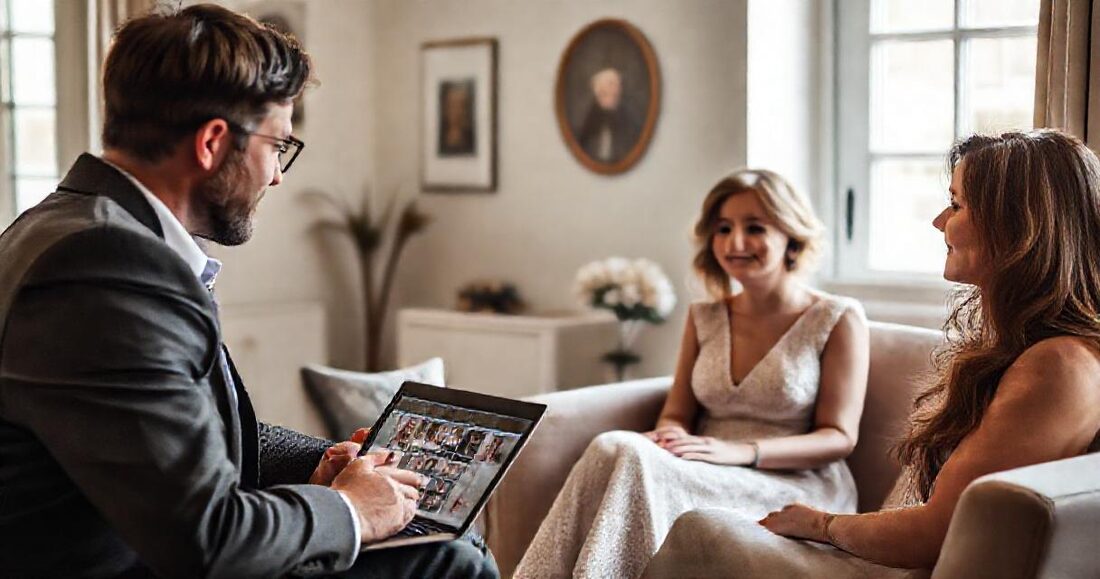
Meet or video-call every shortlisted photographer. You are choosing someone who will be beside you for ten hours on an emotional day; how they make you feel in a thirty-minute call is real data, not a soft factor.
The questions that reveal the most:
- "What happens if you're ill on the day?" A professional has an answer instantly — a network, an association, a named backup. Hesitation here is the biggest red flag in this article.
- "Do you carry backup equipment, and do you back up cards on the day?" Two camera bodies and dual card slots is the professional standard.
- "How many photos will we get, and when?" Vague answers become anxious months later. (Typical: 400–800 for a full day; 4–8 weeks delivery.)
- "How will we receive them, and for how long?" See below — this is the most under-asked question of all.
- "Have you shot at our venue?" Helpful, not essential. A good photographer scouts.
- "What do you need from us to do your best work?" The answer tells you how they think — timeline, light, a family-group list, someone who knows everyone's names.
Warning signs
- No contract, or reluctance to provide one. Non-negotiable for both sides.
- No insurance — many venues require it, and you'd be discovering that late.
- Only shows single images, never full galleries.
- No answer for illness or equipment failure.
- Pressure tactics — "this date will go today" is a sales technique, not information.
- Vague on delivery. "A few months" is not a turnaround.
- Reviews mention communication problems. Weight these heavily; photography complaints are overwhelmingly about responsiveness, not photographs.
Before you sign
Check these are written down: the date and hours of coverage; the deposit and what happens if you cancel or postpone; how many edited images are delivered and by when; whether a second shooter is included; travel costs; what usage rights you get (can you print freely? post freely?); what rights they retain (most photographers keep copyright and the right to show your wedding in their portfolio — normal, but if you'd rather they didn't, say so before signing); and the backup plan for illness.
The part everyone forgets: delivery
Couples spend months choosing a photographer and about nine seconds thinking about how they'll actually receive 700 photographs. It matters more than you'd think — this is what you'll interact with for the next decade.
Ask specifically:
- How do we get them? An online gallery you can view, share and download is the modern standard. A ZIP file emailed once is not.
- How long does the gallery stay online? Some photographers take galleries down after 30–90 days, sometimes charging to restore them. Ask, and prefer photographers whose galleries stay up.
- Can we download full resolution? Yes should be the answer, without an extra fee.
- Can we share with family easily? Good galleries let you send a set of chosen photos to relatives without handing over the whole thing.
- Can guests add their photos? Increasingly possible with a QR code on the tables — a lovely way to collect the day from every angle. See how that works.
If you're comparing photographers who feel equally good, the one whose delivery you'd actually enjoy using is a perfectly rational tiebreaker. You can also browse studios and their real client galleries in our photographer directory — where what you see is genuine delivered work rather than a curated profile.